Friday 13 March 2026
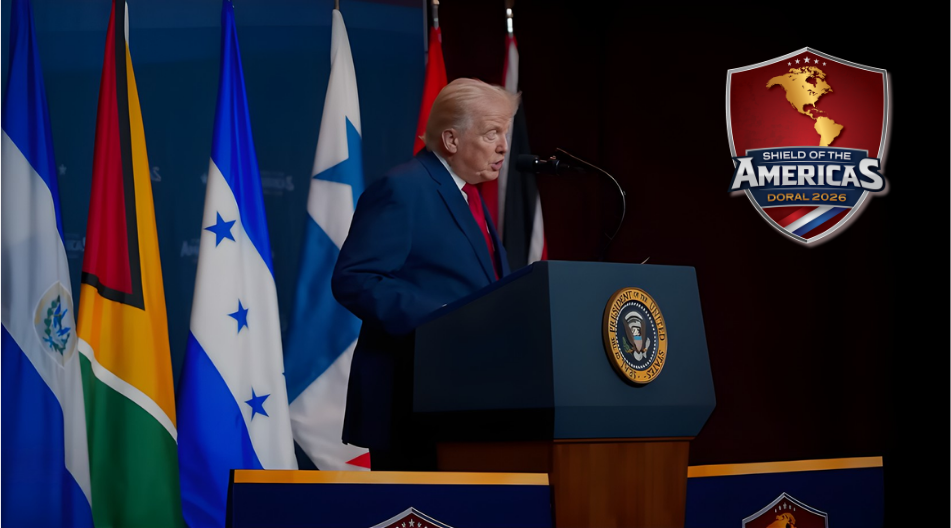
Three Caribbean leaders were among a select group invited to the inaugural Shield of the Americas Summit hosted by US President Donald Trump in Doral, Florida, an event that has sparked both support and controversy across the region.
The gathering brought together leaders from 12 Latin American and Caribbean nations to discuss regional security cooperation, migration pressures and strategies to dismantle drug cartels operating across the hemisphere.
Guyana’s President Mohamed Irfaan Ali, Trinidad and Tobago’s Prime Minister Kamla Persad-Bissessar, and Dominican Republic President Luis Abinader were the only Caribbean heads of government invited to attend.
According to White House Press Secretary Karoline Leavitt, the summit was designed to strengthen collaboration among regional governments confronting similar challenges.
The summit culminated in the signing of the Doral Charter, which established a new security framework known as the Americas Counter-Cartel Coalition (ACCC). The coalition aims to coordinate military, intelligence and law-enforcement efforts among participating nations to combat drug cartels and transnational criminal networks.
During his address to leaders, President Trump framed the initiative as a decisive response to growing criminal activity across the hemisphere. “Every leader here today is united in the conviction that we cannot and will not tolerate the lawlessness in our hemisphere any longer,” Trump said.
He also urged regional governments to adopt stronger security measures against cartels. “The only way to defeat these enemies is by unleashing the power, our militaries, we have to use our military. You have to use your military,” declared Trump.
The US President further emphasised the coalition’s aggressive stance against organised crime. “The heart of our agreement is a commitment to using lethal military force to destroy the sinister cartels and terrorist networks once and for all,” Trump said during the signing ceremony.
Trinidad and Tobago and Guyana formally joined the new coalition during the summit. The move marks a significant shift in regional security cooperation, placing these Caribbean nations more directly within a US-led security architecture.
Prime Minister Kamla Persad-Bissessar defended the decision to participate in the coalition, describing it as a strategic move to address rising crime across the Caribbean. Speaking to members of the Trinidadian diaspora in Florida after the summit, she said joining the coalition would be “in the very best interest of the entire CARICOM, the whole region.” She also praised the US president’s leadership. “We had the distinct honour to really meet with President Trump. He’s a very brave man. He’s a very courageous man because he’s doing what needs to be done, not only for USA but for the world,” she said.
Guyana’s President Irfaan Ali strongly endorsed the initiative, citing the long-standing impact of drug trafficking on Caribbean development. “We agree totally with President Trump. The region itself has made many public comments in relation to drug cartels operating and using our airspace, using our exclusive economic zone,” said Ali in an interview during the summit.
He argued that criminal networks have undermined regional stability and economic progress. “This is not something that was there yesterday. We have always complained about this, and President Trump has taken a direct approach on this issue,” said Ali.
The Dominican Republic emerged as a key partner within the initiative. President Luis Abinader signed the Charter of Doral, positioning his country as a strategic security partner within the new alliance. Abinader said that it would strengthen existing regional security collaboration. “We already maintain a very special role in security matters with intense cooperation; through this programme, that collaboration will become even greater,” he stressed.
Beyond security, Guyana used the summit to advance its growing energy partnership with the US. Ahead of his meeting with President Trump, President Ali held talks with US Energy Secretary Chris Wright to discuss collaboration aimed at strengthening hemispheric energy security. Secretary Wright underscored Guyana’s strategic importance to Washington’s energy agenda. “This is our backyard. We want strong partners, strong nations and strong energy production. Guyana is a huge part of this strategy.”
Despite the participation of several regional governments, the summit has drawn criticism from some analysts and policymakers. Major regional powers such as Brazil, Mexico and Colombia were absent, raising questions about the coalition’s broader legitimacy and geopolitical implications. Still, the participation of Guyana, Trinidad and Tobago and the Dominican Republic highlights the Caribbean’s growing strategic importance in hemispheric security and energy discussions.
Source: Caribbean Insight – Volume 48, Issue 5