Friday 27 February 2026
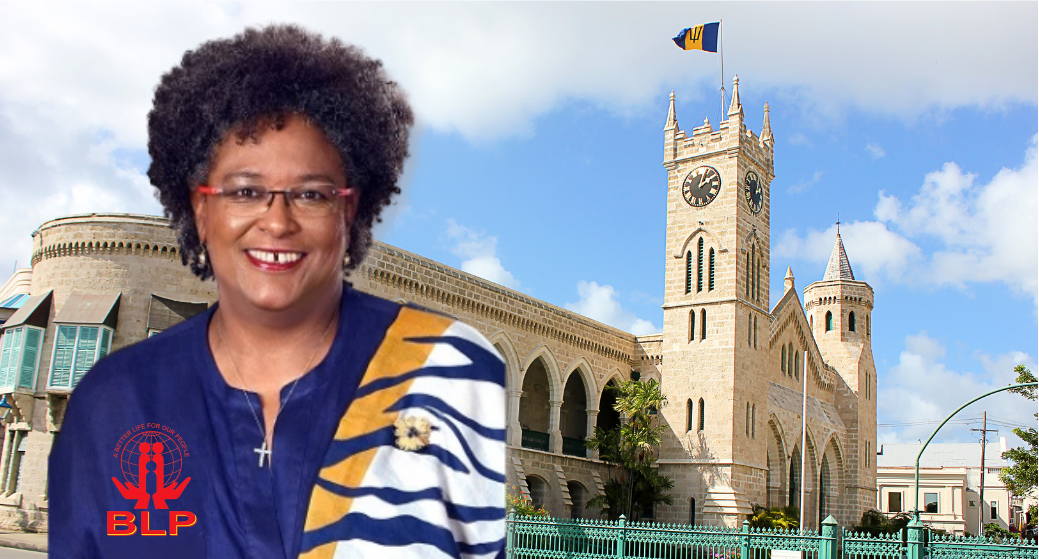
Prime Minister Mia Mottley has unveiled a reconfigured Cabinet days after her Barbados Labour Party (BLP) secured a landslide election victory, taking all 30 parliamentary seats.
Ministers and some senators were sworn in at CARIFESTA House, before the country’s recently installed second President, Jeffrey Bostic, marking the start of the administration’s third consecutive term in office.
At the swearing in of the new government, Mottley attempted to pre-empt criticism; asserting that her team is designed for delivery, accountability and performance in a changing domestic and global environment.
Among the most closely watched appointments is the return of former Democratic Labour Party (DLP) heavyweight Chris Sinckler, whom Mottley has until recently heavily criticised as being one of the architects of Barbados’ “lost decade”.
Sinckler joins the government as a senator and senior minister of foreign affairs and foreign trade. Fellow former DLP minister Michael Lashley also re-enters Cabinet as minister of legal affairs and criminal justice. Their inclusion has fuelled fierce debate among BLP faithful, but underscores Mottley’s willingness to draw talent across party lines.
Defending the expanded and reshaped Cabinet, Mottley said the configuration was intentional and execution-focused. “The Cabinet that is being sworn in today is not just a list of names. It is a structure that has been deliberately balanced, carefully chosen and repurposed to face the current realities of our moment today with strategic focus,” she told the swearing-in ceremony.
Key portfolios were elevated to reflect that priority. Mottley linked a new investment portfolio to economic resilience. “If you ask me why we have a dedicated minister for investment, public and private, it is because our tax base, while our tax collection is doing well, our tax base remains tenuous, and our progress depends on our ability to continue to drive investment, local and foreign investment,” she argued.
The Cabinet retains Santia Bradshaw as Deputy Prime Minister, now Minister of Environment, National Beautification and Fisheries, and leader of government business in the House of Assembly. Kerrie Symmonds takes Energy, Business Development and Commerce as senior minister coordinating the productive sector, while Kirk Humphrey is promoted to Transport and Works and senior minister coordinating infrastructure. Ian Gooding-Edghill and Chad Blackman return as Minister of Tourism and International Transport and Education, respectively.
Ryan Straughn is elevated to full Finance Minister replacing Prime Minister Mottley, Kay McConney assumes public service and talent development, and Lisa Cummins is appointed Minister of Health and Wellness and leader of government business in the Senate.
Mottley acknowledged public frustration with state services, arguing that citizens judge government by lived experience rather than policy documents. “One of the biggest frustrations is often not policy in the governance of this country. It is about the pace of execution,” she said, adding that people care about “whether the bus is coming on time or not… whether the lights stay on, whether their water is running and clear and not brown.”
Noted Caribbean political scientist Peter Wickham described the Cabinet as a sign of political maturity. “I think the big surprise to a lot of people was both Chris and Lashley’s inclusion,” he said, while noting that Sinckler’s foreign affairs experience could prove valuable. On Cabinet size, Wickham observed that it “is actually the smallest Cabinet that she has had,” suggesting consolidation and confidence in leadership.
Beyond Cabinet formation, President Bostic also moved to appoint Senate seats amid the absence of a parliamentary opposition, appointing Ryan Walters and Karina Goodridge as opposition senators after what he described as extensive deliberation.
A further point of contention surrounding the Senate appointments was the DLP’s decision to submit only two names, despite President Bostic formally requesting four nominations. Under normal circumstances, the opposition leader advises the President on Senate appointments. However, since the governing party holds all House of Assembly seats, there was no opposition leader to exercise that role.
The new administration moved quickly to set its legislative agenda, tabling several bills aimed at governance reform and institutional strengthening. Chief among them was a Constitution (Amendment) Bill on party defections, introduced by Prime Minister Mottley, which would require Members of Parliament elected on a party ticket to vacate their seats if they formally change political allegiance.
With ministers sworn in, legislative priorities progressing, and economic reforms promised, the new government has signalled that its third term will focus less on stabilisation and more on performance, productivity and execution across the state.
Photo Credit: https://www.gov.bb/Government/prime-minister
Source: Caribbean Insight – Volume 48, Issue 4